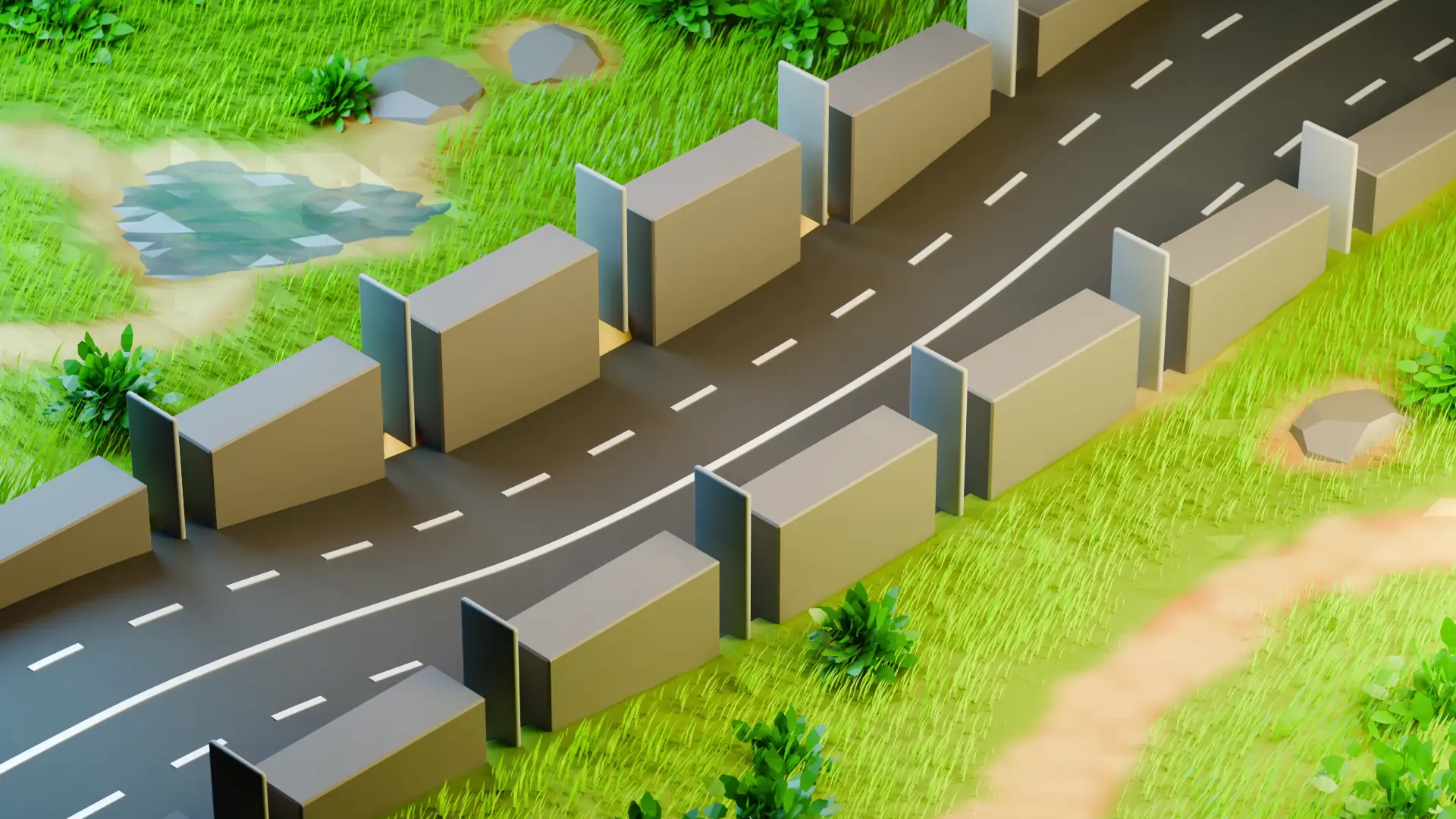
The Caterpillar Effect is a 3D visualisation I made in the interest of the Rijkswaterstaat Dutch Ministry of Infrastructure and Water Management. It animates in a visually clear yet grounded way what happens to tunnels and sunken roads over extended periods of time. The video aims to make the complexity of this "caterpillar effect" visually intuitive and easier to communicate.
Watch the full video:
Background Context
Sunken roads and tunnels consist of several sections with a small gap in between. This is to prevent tearing in the material due to thermal expansion, as the concrete in the tunnel expands in the summer and contracts in winter. The gap in between these concrete slabs is filled with a rubber to prevent breaches in the concrete, but this rubber can start to tear due to ageing. This leads to gaps where dirt can build up. After multiple years of expansion and compression, this dirt accumulates to such a degree that parts of the tunnel start moving outwards by millimeters and then centimeters. Among experts this effect is referred as the ‘caterpillar effect’. This can eventually leads to failure in the anchors that keep the concrete slabs in place, often ruining large parts of the foundation.
This complex physical process is arduous to explain and unintuitive without assistance of visual media, which was not yet readily available. So that's where I come in. I was tasked by a member of Rijkswaterstaat to create a visualization showing off this effect, which could be used to explain the effect to other stakeholders.
The Making of
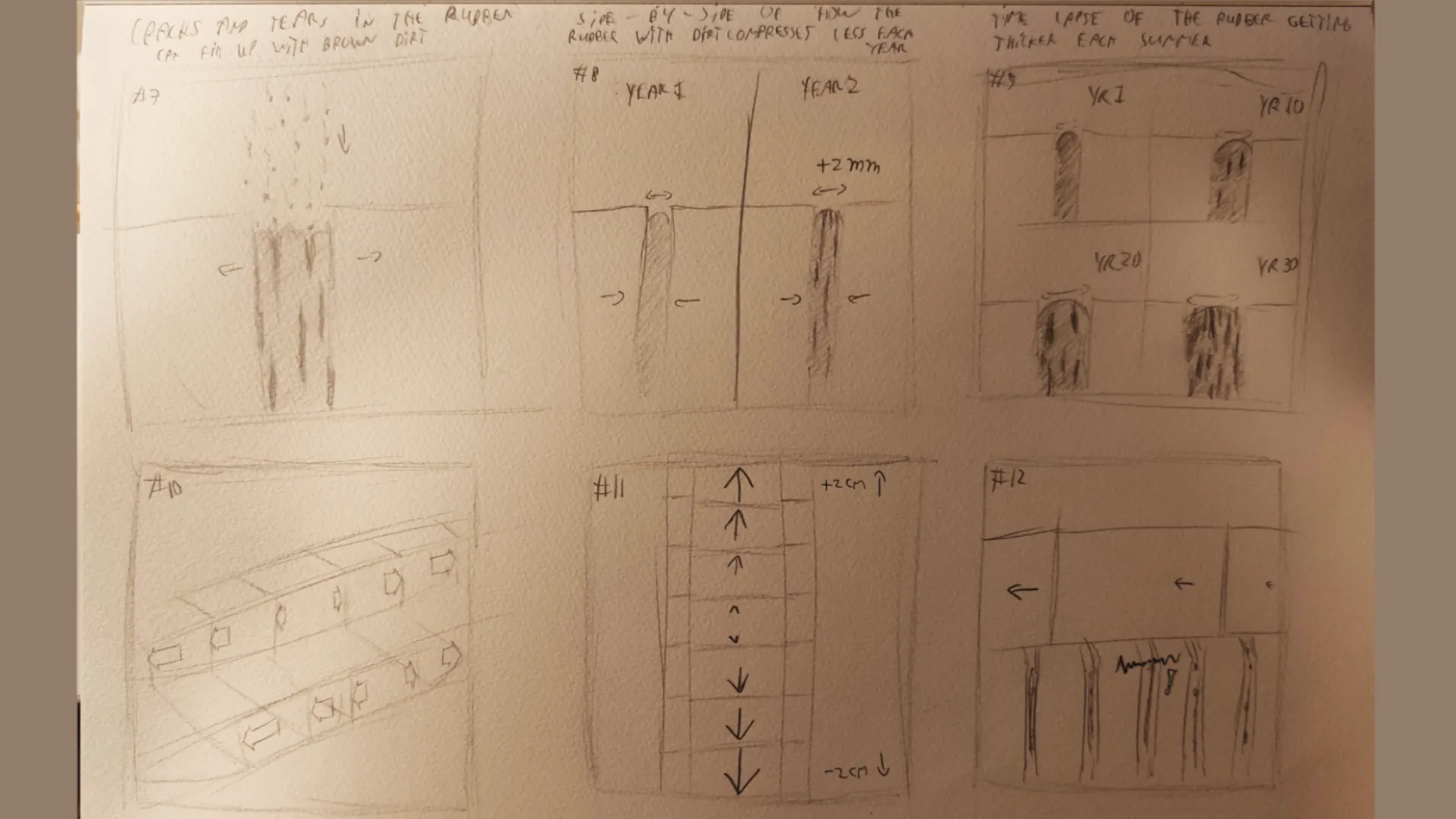
I started out with a rough storyboard, laying out how I wanted to communicate all the nuance of what's actually happening in the material of the tunnel. I then made the bulk of the video in Blender, a 3d software I'm very experienced with. That doesn't mean I didn't have my fair share of challenges, either. Usually when I animate, there is a character that moves, or something is animated by itself through physics and particles. But with this project, suddenly I have a bunch of objects that relate to each other and need to be animated in similar but distinct ways. To make life easier for my future self doing the animation, I learned how to model objects and move them algorithmically, which I was unfamiliar with before this project.
a snippet of the storyboard I made
the algorithmic animation in action: the concrete blocks will always move one after the other
While modeling, I decided to exagerrate the actual physical deformations to make them more visible, while still keeping it grounded in reality. A lot of the movement, expansion, etc of the material is essential to understanding how everything works, so I also added moving arrows and text as extra indicators.
a side-by-side shot, supporting the idea of the layer thickening year by year
The client was extremely happy with the result, and the video is now being used internally to explain the process of the caterpillar effect and its implications.